Catalog
 Sanding materials
 Tools
Tools
 Polishing materials
 Wood finishing materials
 Adhesive
 Painting equipment
 Wood repair materials
 Abrasive discs
 Filters for painting chambers
 Adhesive tapes
 Preparation materials for painting
 Personal safety products
 Industrial equipment

 Sign in


1. Primary sanding of wood:
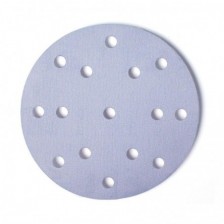
After gluing (extruded glue, raised fiber) it is recommended to sand according to the current quality level: from P80 to P120 grit. It is recommended to sand with the ABRANET ACE/AUTONET sanding disk - you will sand without dust, you will always observe a clean sanded surface.
The advantage of the ceramic grain is that you can sand a larger area to the maximum.
2. Intermediate wood sanding before finishing:
If the surface will only be covered with clear oil, the above-mentioned sanding is sufficient. If you plan to apply tinted oil (with color) or tinted stains, then we recommend sanding with a Q.SILVER disk P150-P180. Because you won't have scratches left on the surface.
3. Preparation of MDF for painting:
Laminated, primed, densified MDF, preliminary sanding before priming is recommended to be sanded with P180 grit. For those with experience in this work, we would unequivocally recommend the ABRANET ACE/AUTONET diskette.
Advantage: ceramic abrasive, you will grind the planes in a larger area than with a regular disc based on aluminum oxide.
Disadvantage: If you are not experienced in grinding the edges, you can damage the disc. As an alternative, if you have no experience, you can safely start grinding with a Q.SILVER disc from P150-P180.
4. Intermediate sanding of MDF primer, insulator:
It is recommended to sand the primed or insulating surface with P240-P320 ABRANET ACE/AUTONET grid or analogue Q.SILVER.
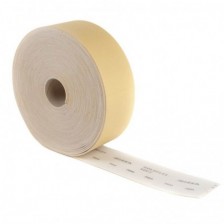
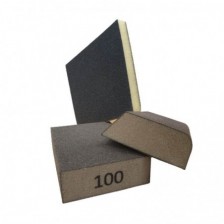
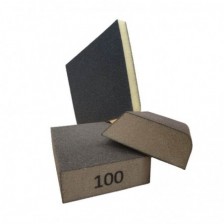
For milled parts, we recommend using GOLDFLEX SOFT P180-P240 and four-sided P100 and two-sided P180/80 sanding sponges according to existing patterns, profiles, and configurations.
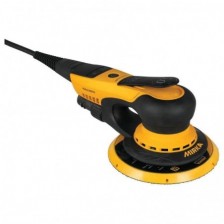
If you are going to sand with glossy paint and polish, we recommend using the DEROS 625CV sander.
5. Intermediate sanding of MDF primer before painting with glossy paint and polishing:
It is recommended to sand everything with a P500-P600 ABRANET ACE/AUTONET disc. This will ensure that the sanded surface is ready for painting without the slightest chance of dust or "pimples".
For milled parts and other configurations, we recommend P400-P600 GOLDFLEX SOFT sanding roll.
6. Polishing of glossy surfaces (paints, varnishes):
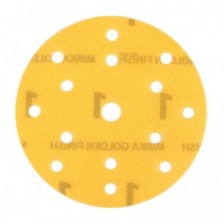
If the surface is painted or varnished and the quality is good enough - when brushed by hand or visually there is light dusting, we recommend light sanding using the sander DEROS 625CV 2.5 mm orbit with GOLDEN FINISH-1 sanding disc.
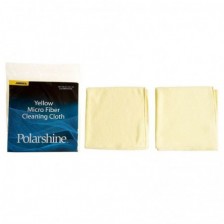
You should see a slightly matte finish on the sanded surface. When sanding, wipe the surface from time to time with an antistatic cloth or napkin. This will ensure the quality of 100 percent cleanliness of the polished surface and prevent the dust from accumulating and turning into a "tablet".
7. Polishing:
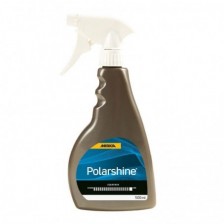
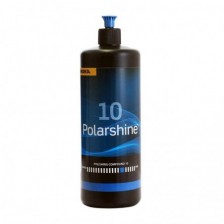
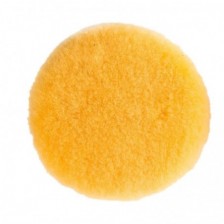
The polished surface is thoroughly wiped with a napkin and we perform polishing work using Polarshine 10 polishing paste and Pro sheepskin.
Water-based polishing paste works significantly better if the surface to be polished is lightly covered with water mist (the surface must not be wet). I recommend moistening the sheep in the same way.
For white parts, it is clear from experience that one liter of paste is used and one shoe wears. That is, it is possible to polish from 30 to 32 sq. meters (with 1L).
After starting to polish the surface, we guide the polisher in circular movements covering (walking) the entire area. During the first two minutes of polishing, the abrasive contained in the polishing paste breaks down into smaller grains and only then begins to polish the part. Do not overheat the surface in any way - the "orange" will shrink.
Check the temperature of the polished surface by hand. The temperature cannot be higher than 50-60 °C. Otherwise, the "orange" effect is guaranteed, if not on the same day, on the following day.
The polished part is thoroughly cleaned with a clean antistan cloth and coated with Polarshine Liquid Nano Wax. 500 ml yields about 35 square meters of area. The part is covered with a light mist (do not pour a drop under any circumstances - it will soak into the surface and spots will remain) and the final polishing is done using a BLACK DOTED sponge in circular motions.
The result - the surface is covered with a NANO film, does not attract dust (to eliminate static charge), does not leave fingerprints and is easy to maintain during operation.